
Connecting the systems your operations depend on
From devices in the field to enterprise infrastructure, systems have to exchange accurate data and stay reliable together. We develop the integration strategy and implement the hardware, communications and software that make it one maintainable system.
Where integration usually breaks
Integration problems are rarely about any single component. They appear at the boundaries: a gateway that speaks a protocol the platform does not expect, a clock that drifts until the records disagree, a PoE budget that was estimated rather than calculated, a network segment that quietly carries traffic it should not.
We design those boundaries deliberately, then test them: interfaces, addressing, time synchronisation, failure behaviour, remote access, update paths and the documentation the next engineer will need.
- Industrial gateways
- Protocol translation, buffering and store-and-forward where links are unreliable.
- Data acquisition
- Sampling, scaling, calibration records and the raw data kept behind every derived value.
- Server & network integration
- Segmentation, routing, remote access and the server side of an operational system.
- Remote telemetry
- LoRa, cellular and satellite backhaul chosen per site, with local buffering on dropout.
- Edge computing
- Processing where the data is created, sized against power and thermal limits.
- Cloud ingestion
- Pipelines, storage and retention that match how the data will be used and reviewed.
- Secure access
- Scoped accounts, MFA and remote management that does not become the weak point.
- APIs & dashboards
- Integration into the tools a client already runs, not another portal nobody opens.
From field device to operating team
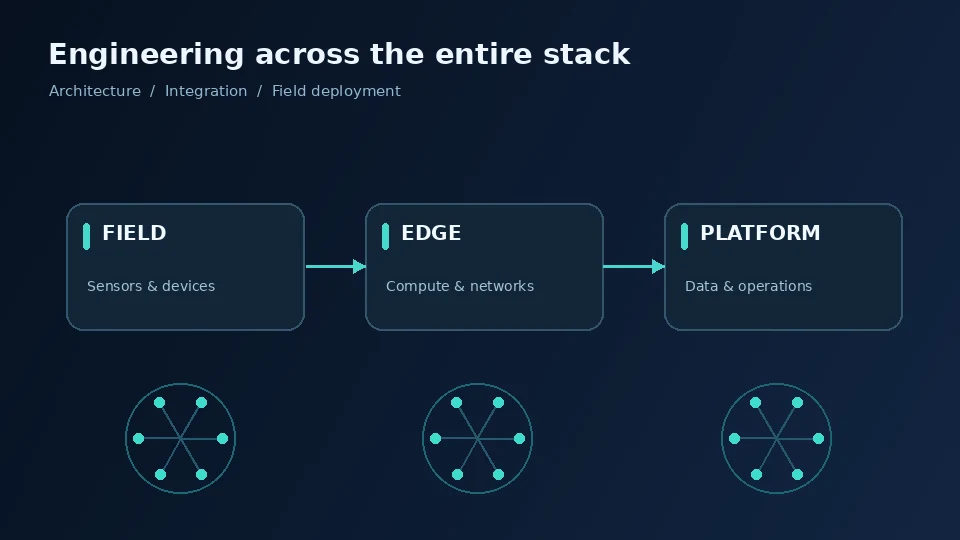
A complete path: instrument or camera, network, acquisition, processing, storage, alerting and reporting. Each stage has an owner, a failure mode and a test.
Where existing infrastructure can be reused, we reuse it. Replacing a working switch or a serviceable server because it is easier to specify than to understand is not integration.
Interfaces are where projects fail
Two systems that both claim to support the same protocol can still disagree about what a value means, how often it is sent, and whether a missed message will ever be retried. That gap is where most integration projects lose time. The work is unglamorous: a written interface specification, a test rig, recorded message samples, and an agreed behaviour for the network dropping at the wrong moment.
We define the contract first, including units, timestamps, time zones, null handling and error semantics, then build against it. Where an existing protocol has to be carried, whether that is Modbus, BACnet, OPC UA, MQTT or a vendor API, we document the mapping instead of leaving it in one engineer's head.
Designed to be handed over
An integrated system that only its author can maintain is a liability. Handover is part of the design: addressing and naming conventions, network diagrams, credentials in a managed store rather than a spreadsheet, alarm routing, backup and restore steps that have been rehearsed, and a short list of the components most likely to fail first.
We also leave a maintenance view, so the next person can see what is being measured, what normal looks like, and which alerts mean something. That documentation is what makes a system survive staff changes, which is the usual reason a working installation quietly stops working.
Related expertise
Procurement, vendor review and the questions that save money
Most integration budgets are decided before anyone writes a line of configuration. A vendor proposal usually bundles hardware, licensing, commissioning and a support tier into one number, which makes it hard to see where the cost actually sits. We break it apart: what is bought once, what recurs annually, what grows with each site or stream, and what the exit looks like if the platform is replaced in five years.
The questions that change outcomes tend to be unglamorous. Does the licence count devices or users. Is the API included or a separate tier. What happens to recorded data if the subscription lapses. Who owns the configuration export. Can the system run offline for a day. A vendor that answers those clearly is usually a better partner than one that answers the architecture question with a diagram.
Working with what is already installed
Replacement is rarely the only option and seldom the cheapest one. Existing sensors, controllers and cabling often carry more value than their age suggests, provided someone tests them rather than guessing. We audit what is in place, record firmware and configuration, and identify the specific components that block the outcome the client wants.
That often produces a smaller project than expected: a gateway instead of a new controller, a switch upgrade instead of a rewire, a documented interface instead of a platform migration. Where replacement is genuinely the right answer, the case is made with measurements rather than preference, and the migration is staged so operations do not stop while it happens.
Have systems that should be talking to each other?
Describe the devices, the network and what has to end up where.