
Video distribution that fits the whole property
A large video installation needs more than individual displays. Channel sources, rights, switching, bandwidth, transport, endpoint hardware, controls and support all shape the experience. We help clients compare architectures and coordinate the technical integration of IPTV and network-based media systems.
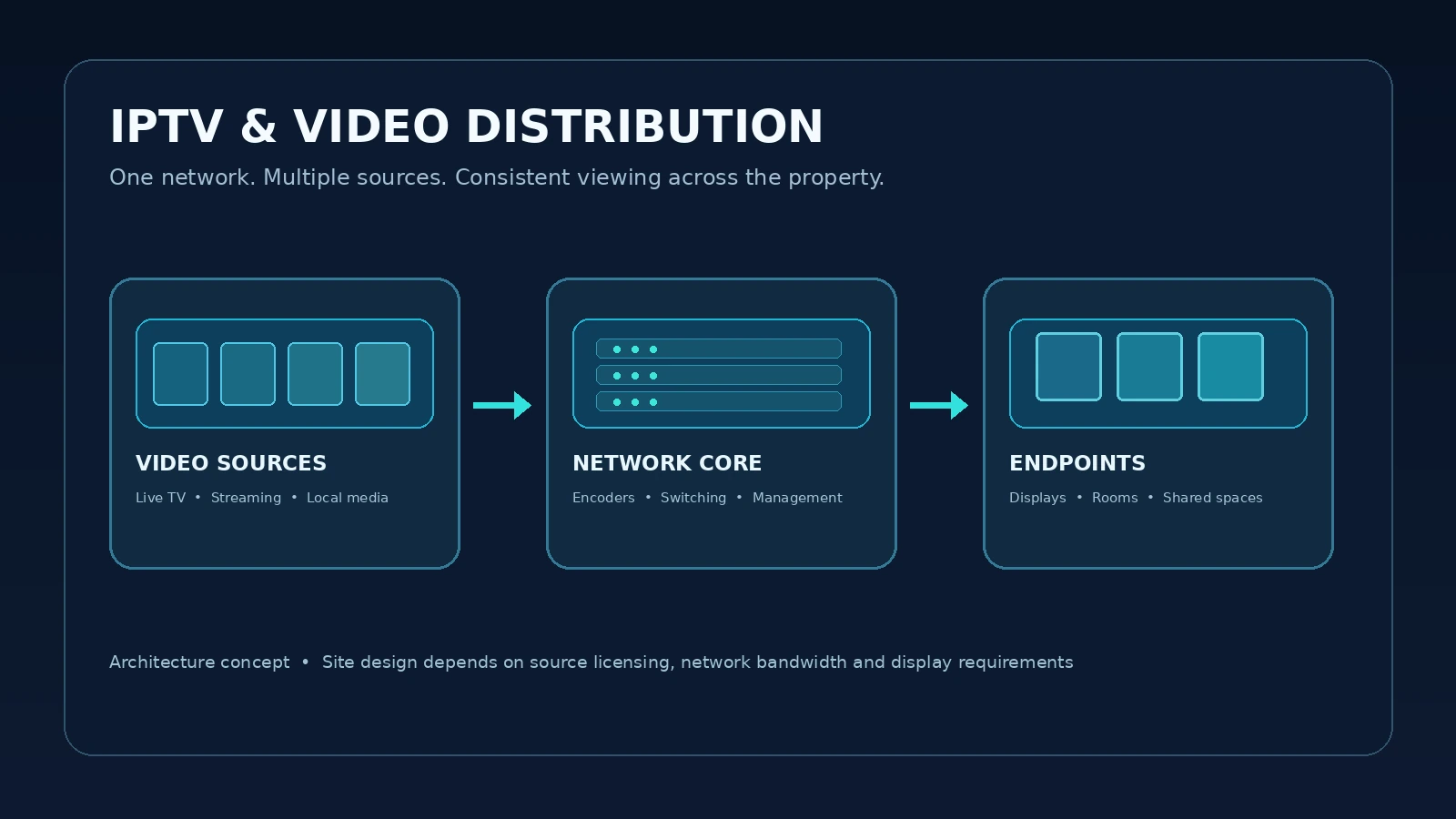
Source, network, endpoints
IPTV is a distribution problem: get the right content to the right screens, reliably, without a support call every time someone picks up a remote. It is not the same discipline as video surveillance, even though both run on the same network, and we keep the two deliberately separate.
Centrally managed content, multiple viewing zones, or a deployment across dozens of displays: the work starts with an infrastructure and operational plan, not a hardware list.
What we plan
The technical questions are predictable: what the sources are, whether multicast is allowed, how much bandwidth each stream needs, how the control interface works for the people actually using it, and what happens when a decoder fails.
- Site assessment
- Existing cabling, switching, racks and the physical path to each screen.
- IPTV architecture
- Centralised or distributed head-end, redundancy and the failure behaviour.
- Network performance
- Multicast or unicast design, IGMP, QoS and capacity headroom.
- Encoders & decoders
- Format, latency and the endpoint hardware that fits the room.
- Display endpoints
- Placement, control integration and remote management of each screen.
- Control integration
- One remote, one interface, and behaviour a guest can work out unaided.
- Vendor evaluation
- Where the differences matter, and where the specification is noise.
- Documentation & leadership
- As-built records, handover and technical oversight through delivery.
Rights and licensing
Content distribution rights belong to the client and are secured by the client. We do not promise access to subscription content, particular channels or DRM interoperability without reviewing the specific arrangement first — and we will say plainly when a proposed architecture depends on a licence that may not exist.
Where a property already has an estate network, the IPTV design has to coexist with it: VLANs, bandwidth policy and the fact that a household's evening traffic is not going to be polite about it.
Multicast, unicast, and what the network will carry
A hundred screens showing the same channel is a multicast problem: one stream on the network, many listeners, and a switch configuration that has to be right or the whole segment suffers. A hundred screens showing different channels is a bandwidth problem with a different cost curve. Deciding which model applies, before the endpoints are specified, is the difference between a system that scales and one that is rebuilt in year two.
We plan the distribution path end to end: source and encoding, transport, switching and IGMP behaviour, endpoint decoding, and the control layer that lets someone change a channel without a support call. Where a site has existing cabling that can be reused, it is measured rather than assumed.
Rights, latency and the operational reality
Content rights, licensing and regional restrictions constrain the architecture as much as bandwidth does. A design that ignores them produces a technically elegant system the operator cannot legally feed. We map the sources and their terms early, then choose an approach that survives an audit.
Latency expectations matter too. A scoreboard feed, a gym wall and a hospitality screen have different tolerances, and the endpoint choice follows. We also design for the day something breaks: which screens keep working, how an operator is told, and what the fallback is when the source disappears.
Where a property already distributes video for security or operations, we look at whether that network can carry both duties before adding a second one. Sharing infrastructure is often the cheapest option and the fastest way to break a camera system, so the capacity and quality-of-service assumptions are written down before anything is combined.
Related expertise
Endpoints, control and the operator experience
The endpoint is where a distribution project is judged. A screen that takes twelve seconds to change channel, or needs a site visit to fix, undoes the benefit of a well-built headend. We treat endpoint selection as an operational decision: power method, mounting, remote management, firmware policy, and how a non-technical person recovers it when it misbehaves.
Control is designed with the same restraint. The people who change channels day to day should not need to understand the network, and the people who run the network should not be asked to grant them more access than that task requires. Where a control system already exists, we integrate with it rather than adding another remote.
Planning video distribution for a property or facility?
Tell us the sources, the screens and the network that already exists.